
The simple definition of capitalism given by the dictionary is “an economic and political system in which a country’s trade and industry are controlled by private owners for profit, rather than by the state” (dictionary.com). This definition is accurate, but there are many other factors that go along with a capitalist society that are passed off as inherent norms, never to be questioned. Capitalism is the basis of the world economy and because of this, many people can’t imagine another way to organize economics and society. However, there are several direct consequences of capitalism that must be considered. The social and economic system of capitalism directly oppresses people of color, women, and the lower class through institutional racism, sexism, and classism.
Capitalism was born from racist violence, and perpetuates racism today (Fraser 2019). The beginning of America’s capitalist economy was built off of slave labor. America could never have flourished economically as it did without the forced, unpaid labor of millions of Africans. Slavery produced the cotton that served as the base for modern capitalism, and from there, the slave system expanded, entrenching American productivity in a racialized labor system inherently built off of inequality (Williams & Brogan 1964). The labor system of slavery is somewhat reflected in the current system of labor relations. 74.4% of fortune 500 CEOs are White men, just as nearly all slaveholders were White men (Zweigenhaft 2013). People of color tend to hold service occupations subject to more variable hours and greater job turnover, and on top of that, African American men who work full time only earn 74% of what their White counterparts earn (Simms & Kijakazi 2017). So, though slavery is illegal, Black people are still being punished and treated unfairly on account of their race, just like before the passage of the thirteenth amendment. This inequality is in no way justified. Black people were not enslaved because they were inferior to White people, and Black people do not continue to face injustice because they are inferior to White people. Slavery was not born of racism: rather racism was the consequence of slavery (Williams & Brogan 1964).
Along with racial inequality, capitalism was built upon gender inequality. After the Industrial Revolution, men went to factories to work and women stayed at home to care for the children, and this is the expectation that has continued, leaving no room for women or men to break out of their narrow roles. Men are free to have a career but not to stay home with their children while women must have no ambition outside of homemaking. In this way, capitalism reinforces gender roles and rules for who can do and be what. However, gender inequality did not start with the Industrial Revolution. Women have always been seen as inferior to men in Western culture, and this is apparent in the document that serves as the basis of laws and rights in America. Women and their voices were completely excluded from the framing of the Constitution as it was written solely by bourgeois White men (Galindo 2013). The language of the Constitution is also indicative of its writers, with phrases like “All men are created equal” being particularly transparent as to who made the rules for the country and for whom they were made. Although, as mothers do not contribute to the acquisition of capital directly, they do provide a service vital to capitalism; they create more workers that feed into the capitalist machine. Though her role is undervalued by capitalist society, woman’s contribution is arguably the most important one. As women are not seen as workers, but as instruments of production, their reproductive systems have been appropriated as another cog in the capitalist machine (Heilbroner 2000).
Not just women and Black men, but those of the lower economic class suffer as a result of capitalism as well. Capitalism is organized so that the bourgeoisie retain their wealth and social power, and the proletariat incessantly work to survive, all the while building the bourgeoisie’s wealth. Workers get paid only for their “true value”, the amount of money needed in order to exist, even if their labor exceeds that value, which the capitalist system makes sure it does. This unpaid work, the “surplus value” of the worker’s labor, is gained by the employer and kept as capital. Essentially, workers are paid only as much as they need to survive while the capitalists profit off of their exploitation, maintaining the low status of the worker and increasing the wealth of the employer (Heilbroner 2000). The people’s labor is exploited for the economic gain of the bourgeoisie in a system designed to maintain and exacerbate the class hierarchy and unequal distribution of wealth. In this way, the labor of the lower class, and therefore the lower class itself, is undervalued and underpaid, their toiling under the capitalist regime furthering their own subjugation while directly benefiting their oppressors.
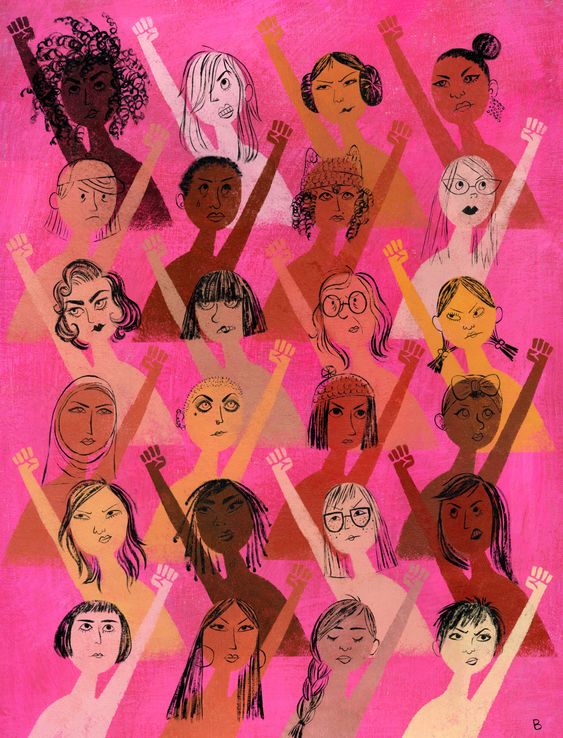
The number of magnates of capital is constantly diminishing while the mass of exploited workers grows; capitalism’s benefiters dwindling while its victims multiply (Heilbroner 2000). As women, Black people, and the poor become more fed up with their situations, they are beginning to realize that things do not have to be this way. With unemployment rates, the cost of living, and the Earth’s temperature rising, so rise dissent and resistance. The new generation suffering the social, economic, and environmental consequences of baby boomer capitalism will rise up and overthrow the oppressive system, bettering all aspects of life and leaving the world improved for following generations. Society is at the point where the injustices imposed by capitalism are being realized, and something can and must be done about them.
References
Dictionary.com. (n.d.). Retrieved from https://www.dictionary.com/
FRASER, N. (2019). FEMINISM FOR THE 99%. Place of publication not identified: VERSO.
Galindo, M. (2013). No se puede descolonizar sin despatriarcalizar: Teoría y propuesta de la despatriarcalización. La Paz, Bolivia: Mujeres Creando.
Heilbroner, R. L. (2000). The worldly philosophers: The lives, times, and ideas of the great economic thinkers (7th ed.). London: Penguin.
Simms, M., & Kijakazi, K. (2017, March 29). Structural racism places the burden of proposed budget cuts on people of color. Retrieved from https://www.urban.org/urban-wire/ structural-racism-places-burden-proposed-budget-cuts-people-color
Williams, E. E., & Brogan, D. W. (1964). Capitalism slavery. London: A. Deutsch.
Zweigenhaft, R. L. (2013, December). Power in America. Retrieved from https:// whorulesamerica.ucsc.edu/power/diversity_among_ceos.html


 gee-whiz grace